
Speed Secrets: Why Do You Make Those Mistakes?
Why do we do what we do on track, even when we know it’s the not the right thing?

The first step in making an improvement in anything is fully understanding what’s in the way—the WHY behind what’s holding you back from taking your driving to the next level, perhaps.
I was thinking about this recently, and then the following list of skills, techniques and challenges popped out of my head and onto my digital paper. From there, I thought about—and wrote about—why each of these things holds us back from performing better on the track.
Iʻm not sure Iʻve identified every reason for the issues below, but I hope I got the majority. And the most important ones, too. Still, I’d love to hear your thoughts and input on what I might have missed. If you have anything to add, please click on the Comments button at the bottom, and post your thoughts and ideas. Together, let’s see if we can complete this list.
[Warning: This is a long post, with a long list of mistakes and causes.]
Turn in early:
Let’s start with one of the most common mistakes. Why do drivers turn-in early for a corner?
Often, it’s fear/self-preservation based. Approaching a corner at high speed can be intimidating, and when we get that feeling, we want to do what feels safe. Moving away from the outside of the corner, tucked in close to the inside gives us a sense of avoiding the big scary monsters on the outside of a turn. And the sooner we get away from them, the better! So, learning to feel safe and comfortable turning in later, at the right point in a corner, is the key to improving.
If you don’t have a clear mental picture of where you’re going, you won’t know how to get there, and it’s likely that you’ll turn into corners early because it seems like that would get you somewhere sooner.
The final reason (for now) is simple: You have a habit of turning in early. I think of habits as mental programs, and you can re- and de-program your mind. How? By overwriting it with a stronger, better and even more-rewarding habit. But if you’ve developed a habit of turning in early, you’re going to continue to do so until you change—re-program—it.
Brake too early:
For many drivers, fear, self-preservation and a lack of confidence lead to braking early. Or, at least, braking earlier than necessary.
But, as astronaut Chris Hadfield has said, “Fear is just a symptom of lack of preparation.”
One way the best drivers prepare for a corner is by looking well into the upcoming corner, to where they’re going to finish, or end, braking. Yes, mentally and visually focusing on the EoB (End of Braking) when approaching a corner will make it easier to begin braking later. Similar to early turn-ins, if you don’t know where you’re going, how do you know how to get there? If you don’t know when you’ll be ending your braking, how do you know when to start? If you know when to end your braking, you’ll be better prepared, feel more confident,and begin braking appropriately.
If you’re not looking towards the turn-in point and EoB as you approach the brake zone, you may end up braking early.
Finally, a common cause of braking early is making the initial application of the brakes soft and slow. When traveling at your highest speeds, you may be able to brake harder than you think. If you don’t do that, you convince yourself that you’re already as late on the brakes as possible, and continue to apply them at the same place.
Brake too late:
Some of this is caused by the mindset that later braking will always make you faster. You may have beentaught this, or feel that you’re gaining on other cars on track by delaying when you begin braking.
I doubt there is a driver in the history of racing who hasn’t felt that later braking results in being faster. Itʻs the time/distance paradox: if you’re two seconds behind a car at 100 MPH, the distance is much more than it is at 50 MPH. So, as your speed slows in the brake zone, even if you stay exactly two seconds behind, the distance between you and the car ahead shrinks. And that makes it seem like you’re gaining, when you could still be the same amount of time behind the other car. When you close up behind someone, it’s seems logical that you’re faster. But what matters most is time, not distance.
On the flipside, it also seems logical that the less time you spend braking, by compressing the brake zone (by braking later), you will be faster. That is often true, but not always. If, by braking later, you brake harder (which is what most drivers do instinctually), and your corner entry speed is the same (or even slower because of the harder braking), you won’t be any faster around the length of the lap.
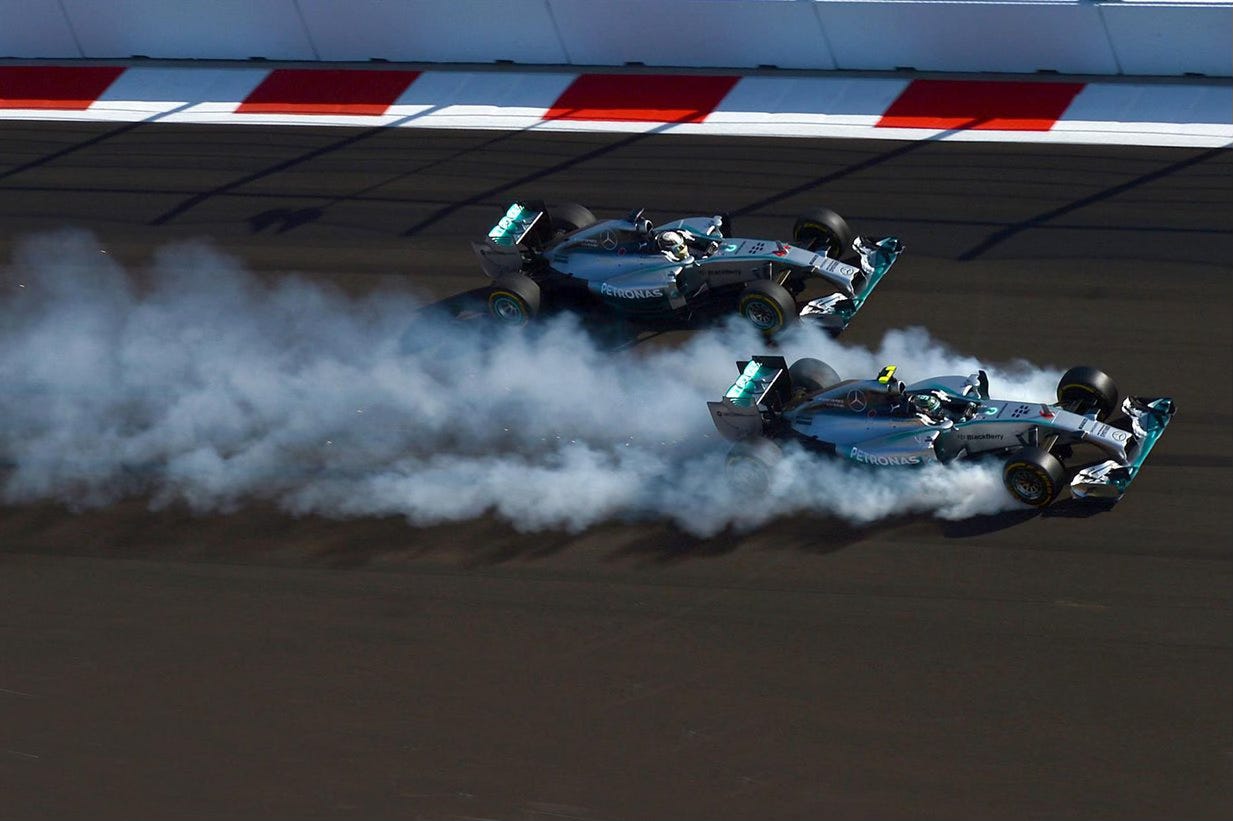
As I’m sure you know, there are times when braking earlier, but lighter, actually results in carrying more speed into and through a corner, which then results in a faster overall lap time. Braking later goes against the idea of braking lighter, so, instead, you brake later and harder.
Over-slow for corners:
The number one reason I see for over-slowing is being overly-focused on the BoB (Begin on Braking). I know this may be sounding a bit repetitive, but if you don’t know where you’re going, and the speed you want to be at when you get there, you’ll often overreact and over-slow.
A common cause is the initial application of the brakes being too soft, resulting in the feeling of being too fast as you approach the turn-in, and then increasing brake pressure (like most drivers do when driving on the road and approaching a traffic light). Instead, if the initial application of the brakes is strong, then as you get close to the turn-in point, you can modulate the pedal to fine-tune your corner entry speed. But if you’re intimidated by the speed you’re carrying as you approach the turn-in, you’ll hang on the pedal too long and take off too much speed.
