
Speed Secrets: References, References, Everywhere are References
The driver with the most references wins.

The more references you have, the fewer mistakes you will seem to make. You may make the same number of mistakes, but the corrections will be so small that it will seem as though you’re not making any.
I often use the following illustration to compare how two drivers can be presented with the same view ahead of them on track, and yet one will be more consistent—and often faster—than the other. Want to guess which one?
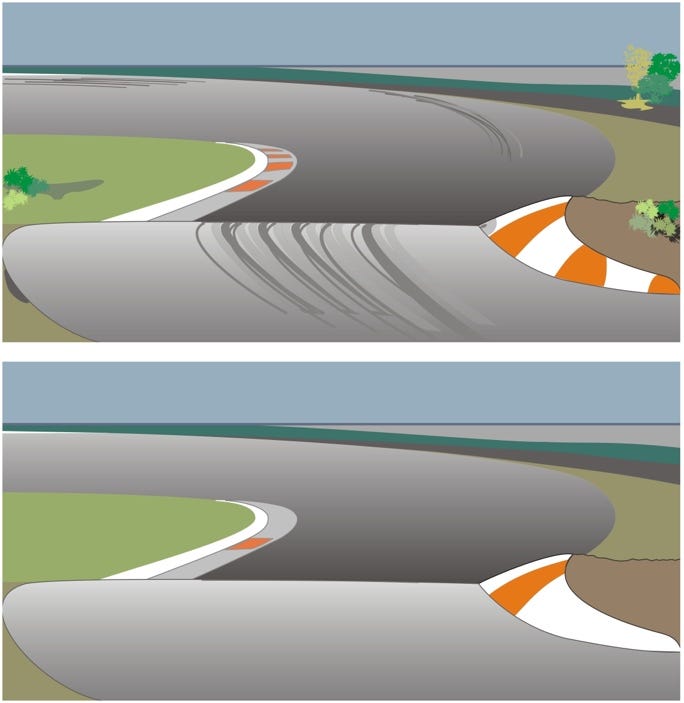
After hearing me talk about this (or read what I’ve written on the topic), some drivers will comment in variousways about their use of references.
“I don’t really have many, if any, visual references. I just go by feel.”
I get it. There are two ways I’d like you to think about this. First, references are not all visual things. Some references you feel from the track (bumps, quick elevation changes, etc.), and the more of these you notice and file away in your mental database, the better you’ll drive. And some references are auditory—you hear them more than you see or feel them. So, just because you don’t have many (or any) visual references, I’d bet that you do have many more feel and auditory references than you give yourself credit for.
Second, many drivers do feel their way around the track, but I’d argue that some of that “feel” is actually a sight picture. You may not have one single point that you see, that tells you when to brake, turn the steering wheel, or anything else. Instead, your eyes take in multiple objects and sightlines and almost “triangulate” them into seeing a bigger picture that triggers your brain to tell your hands, arms, legs and feet to do something.
While it might seem as if you don’t use references, I believe that you do, even if that means you know when to turn into a corner, for example, when the overall sight picture looks just right.
In other words, sometimes feel is a “sight picture”—a picture of an entire scene, as opposed to individual objects and images.
“I have a hard time remembering what I use or see.”
You’re not alone. Many drivers feel that way, wondering why they can’t remember what they saw or felt on track. Mostly, this is because you’re operating, as a driver, in a subconscious mode, and not in a “I have to think about this, then that, and more of this again, and so on…” mode. In other words, you’re trusting your mental programming to drive the car, which is a good thing because your conscious mind cannot keep up with the speed of a car on track.
Have you ever driven somewhere on the street, gotten there, and then realized you couldn’t actually remember having driven there? I bet you have. The good news is that you were driving at a subconscious level, with your mental programming doing a good job of getting you to where you wanted to go. The bad news is that you may have missed something important along the way.
Keep reading with a 7-day free trial
Subscribe to DRIVING DIRECTIONS: Ross Bentley's Speed Secrets to keep reading this post and get 7 days of free access to the full post archives.