
Speed Secrets: Models, Principles & a Deeper Understanding of Braking
There’s more to braking than meets the eye… or the foot.

As promised, every once in a while, I’m going to share a mental model or principle that, if you really understand it at a deep level, will help you make better driving decisions, learn and improve quicker and constantly, and perform even better. (These posts may be part of the free subscriptions, or only for paid subscribers.)
This week, I’m looking at what happens when you approach and enter corners: braking.
But first, according to Wikipedia, “A mental model is an internal cognitive representation of how something works in the real world. Acting like a simplified map, it compresses complex systems into manageable concepts to help people reason, make decisions, anticipate events, and solve problems.”
Your goal should be to internalize a mental model to the point where you understand it at a level where you no longer have to think about it; it simply triggers a subconscious response and action. That’s why this is so important.
Let’s start with a model for what the braking phase actually includes:
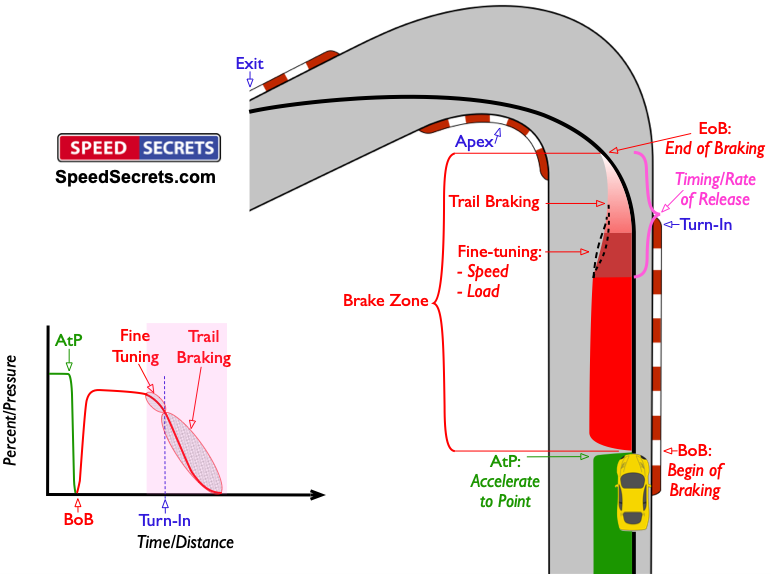
A few things that are important to keep in mind when you look at this illustration:
The AtP and BoB are as close together as possible.
Braking is a zone, and not just points, and it’s defined by the area between the BoB and the EoB.
Most drivers think of the braking phase as a point where they begin braking—the Begin-of-Braking, or BoB. As you can see from the illustration, the braking phase includes much more than just where you begin braking.
The EoB is the point where your foot finally comes off the brake pedal (if I was behind you, your brake lights would go out at this point).
The fine-tuning zone begins about one to five car lengths before the Turn-in point, and is where you decide what you want to do with the brakes to set the ideal corner entry speed, as well as whether you want to keep the front tires loaded or not.
The timing and rate of release begins in this fine-tuning zone and ends at the EoB.
Notice how all of this is related to the graph of throttle position and brake pressure, and most importantly, know that the shape of the brake trace is infinitely variable.
Ultimately, your corner entry and minimum speed, as well as when you’re able to go back to throttle, is determined by what you do in the brake zone.
Obviously, the details of this model changes for different types of corners (whether the priority is exit speed, entry speed, or compromising for upcoming corners), the speed you approach and carry through them, their shapes, whether there is elevation or camber changes, and the type of car you’re driving. But the components are the same. The only type of corner that doesn’t fit this braking model is one where there is no braking whatsoever!
Remember something that I say all the time: You do what you do while driving because you’re programmed to do so; sometimes you don’t do what you want because you don’t have the right programming yet. In other words, these programs have become habits, and they’re things you do without much, if any, conscious thought.
After being told to brake at the “4” marker, or beginning to brake there because other drivers were braking there, you develop a habit, or a mental program, to do that.
With more experience, and a desire to lower your lap time, a common thought that comes to mind is, “I’ll brake later because that will make my lap times faster.”
Two things here. First, braking later might lower your lap times, or it might not. If you’re already at or near the limit with your braking, moving your BoB further into the corner will not help much, if at all.
Keep reading with a 7-day free trial
Subscribe to DRIVING DIRECTIONS: Ross Bentley's Speed Secrets to keep reading this post and get 7 days of free access to the full post archives.